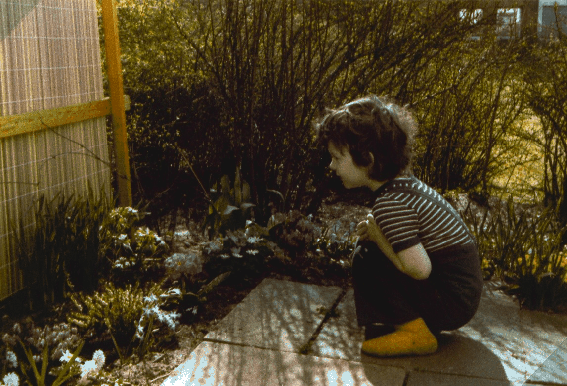
with the LECTRON electronic kit starting at about 4 years of age.
Audio: Anton Bruckner - Symphony no. 8 - III (1/4), Bernhard Haitink conducting the Royal Concertgebouw Orchestra Amsterdam.
|
|
My son Michael, April 1974, and some of his hobbies 35 years later, perhaps a consequence of his having played with the LECTRON electronic kit starting at about 4 years of age. |
Video: Gerhard Richter, Abstrakt ab 2005 Audio: Anton Bruckner - Symphony no. 8 - III (1/4), Bernhard Haitink conducting the Royal Concertgebouw Orchestra Amsterdam. |
My personal annual reports:
|
|
|
|
60 years from now our oil and gas reserves will have been used up. Also,
the Intergovernmental Panel on Climate Change
has stated that a reduction of the energy use in private households to
30 % of the present level is one of the requirements to keep the carbon
dioxide concentration in the atmosphere at its present level.
Therefore, any heating system that relies on these has no future, much
like a "gas guzzler" automobile.
To get an impression of the beauty of this National Park, start on the
web site of the Tourismusverband
Mecklenburg-Vorpommern and navigate to the page describing the "Mecklenburgische
Schweiz".

Läuten der Freiheitsglocke im Schöneberger Rathaus von Berlin. Sie ist am 24.10.1950 der Stadt übergeben worden als Geschenk der USA mit einem Bekenntnis von 17 Millionen seiner Bürger zur Freiheit:
"I believe in the sacredness and dignity of the individual. I believe that all men derive the right to freedom equally from God. I pledge to resist aggression and tyranny wherever they appear on earth."
Sie läutete damals das erste Mal. Daran wird im Deutschlandradio Kultur jeden Sonntag um 11:58 Uhr mit einer Übertragung erinnert.
The digital revolution that brought us Facebook, Twitter and YouTube could help revive participatory democracy in the U.S., says Eugene J. Huang. He unveils the FCC's plan for providing broadband access to every American, and describes how its recommendations could spur more open government and greater civic engagement.
To me this is a fascinating and colorful story about some rather relevant differences between the American and the German culture, e.g. the interpretation of human rights in the United States and how immensely satisfying it is to incorporate this practical, loving approach in our (German) lives. The author's view of our German culture has helped me assess the problematic sides of my background and set free a most welcome energy towards active participation in shaping my social environment.
I am confident that the "Princess" will gradually contribute to a change in general attitude towards, understanding of, and cooperation with the world in which we live - and thus with the New World as well..
Summary (German Summary)Berlin 1922.
Pandemonium reigns in the capital of Germany after the Allied victory in World War I and the fall of Kaiser Wilhelm II (in the Weimar Republic). The proletariat have swarmed out, waving the red banners of Communism; private armies of unemployed, disaffected veterans - Freikorps- roam the streets thrashing the Communists. An explosion of radical music, theater, and art manifests the seething rancor and nervous energy of the people. The most insane, paralyzing inflation the world has known makes life a misery for the hungry, desperate populace. Although the flower of their kind lie buried in Flanders fields, a few aristocratic families preserve their privileged, even exquisite lives: boating parties at summer palaces, chamber music in great townhouses on Sunday afternoons.This is the rich backdrop of "A Princess in Berlin", a social novel in the grand tradition of e.g. Theodor Fontane in the Germany of the 19th century.
Into this feverish society comes Peter Ellis, a young American from Philadelphia who was an ambulance driver on the Western Front. In Paris, given a year by his Quaker family to get over his shell shock, Peter encounters a former German officer, Christopher Keith, whose life he saved at Verdun. Christoph is shepherding the young Bobby von Waldstein, a family of Berlin bankers, once Jewish. At their urging, Peter agrees to come to Berlin, to study painting. There Peter is ushered into the Waldstein milieu, where he meets Max Liebermann (who will in 1933 say "Ich kann garnicht soviel essen, wie ich kotzen möchte!") (see also 1) and Walther Rathenau (see also 2,), then foreign minister of the German government. Princess Helena, a daughter of the Waldstein family, is a good friend of his, and through her and her brother, Peter realizes the sadness with which (the hated and despised Jew) Rathenau tries to moderate politics and social life in Germany.
Peter lives part of his life in Neukölln, where he studies painting with Fritz Falke, a former student of Liebermann, and with Fritz he experiences the misery in Berlin, which the Quakers, and Susan Boatwright in particular, try to alleviate. Berthold Brecht's songs in Kneipen (pubs) and on parties reveal the dark and dangerous side of the German character, the "anger, bitterness, sullenness and discontent" (J. Robert Oppenheimer about Germans in 1927).
Peter is dragged into attempts to sabotage the murder of Rathenau, in the aftermath of which Helena and Christoph are murdered and Peter hardly survives.