Tritium Studies
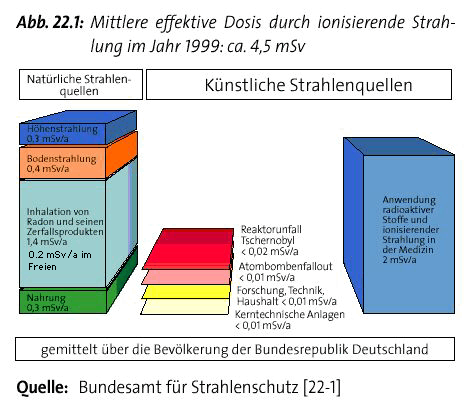
The total tritium inventory in a fusion reactor would be about 1 kg whilst the amount discharged into the environment during normal operation should be less than 2 g per year, so that the dose received by the general public would still be less than 1% of the dose due to natural radioactivity.
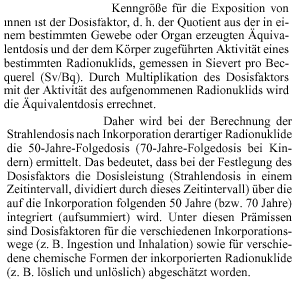
Taken form the National Council on Radiation Protection (NCRP) report 30, the Annual Limit for Intake (ALI) is 80 mCi and the Committed Effective Dose Equivalent (CEDE) in soft tissue is 64 mrem per millicurie (mCi) ingested.(The ALI is the amount of activity required to receive a dose of 5 rem of equivalent whole body dose for the year. To use the given CEDE dose factor to calculate the dose, estimate the amount of tritium initially deposited in the body, and divide by 1 mCi/64 mrem. The ALI and the CEDE factor are based on the biological half life of 10 days.)
An example of using the CEDE factor:
If a worker ingested 4 mCi of tritium, the worker would receive a dose of 256 mrem.
GEOTRAP is the OECD/NEA Project on Radionuclide Migration in Geologic, Heterogeneous Media. GEOTRAP is devoted to the exchange of information and in-depth discussions on present approaches to acquiring field data and testing and modelling flow and transport of radionuclides in geologic formations for the purpose of site evaluation and safety assessment of deep repository systems. This information is important for both national waste management programmes and the wider scientific community.
The scope of this annex includes reviews of:
- Radiation-induced alterations of the immune response, including immunosuppression (depression) or immunostimulation (activation);
- Possible mechanisms by which the immune system is altered following exposure to ionizing radiation;
- Epidemiological assessments of immune system alterations in various diseases, with emphasis on the effects of ionizing radiation.
see
Importantly, a growing radiosensitivity among the individuals of a population over generations would mean that research used to predict radiation damage, if based on data from earlier generations, would not be reflective of damage to the current generation. Likewise, research used for long-term radiation exposure protection that relies on controlled experiments could be extremely unprotective. These two scenarios call into serious question our current radiation protection systems.
Referencing studies summarized in his book, Chernobyl: Consequences of the Catastrophe for People and the Environment, Alexey Yablokov states:
Studies examining Chernobyl animal populations living in chronic low-dose radiation (summarized by Goncharova in 1998) show an increase in radiosensitivity among those whose ancestors were exposed. This indicates that successive generations could be less able to cope with the same degree of exposure as their parents were and that, for certain animal species, there is no genetic adaptation to mutations from low-dose, chronic, man-made radiation exposureÑthe kind received from nuclear power whether or not there is an accident.
All of the populations of plants, fishes, amphibians and mammals studied there are in poor condition,Ó he continues. ÒThis zone is analogous to a Ôblack holeÕ, in which there is accelerated genetic degeneration of large animals Ð some species may only persist there via immigration from uncontaminated areas. The Chernobyl zone is a micro-evolutionary ÔboilerÕ, where gene pools of living creatures are actively transforming, with unpredictable consequences. We ignore these findings at our peril.
Prepared by the Global Environment Monitoring System - Food Contamination Monitoring and Assessment Programme (GEMS/Food)"
in collaboration with Codex Committee on Pesticide Residues
Programme of Food Safety and Food Aid World Health Organization, 1997
cached version - abbreviations used