by Joachim.Gruber(at)acamedia.info
|
|
ARTS
KUNST
- Geosciences
- Radioactive Waste Behavior in the Environment
- Oberflächenspeziationsprogramme: kein grundlegendes Verständnis der Adsorptionsvorgänge
- Particle Removal Velocities in the Mecklenburg Bay
- Umwelt-Desaster im Atommülllager Asse II: Kommentare zum Blog
- Standortauswahlgesetz
- Kommentar (Cache) zum Blog von Jochen Stay
- Beiträge zum Bürgerforum Standortauswahlgesetz
- Endlagerung von hochaktivem Abfall (HLW) (Übersicht)
Abfallfragen- Strahlenschäden in NaCl
- Ungelöste Probleme
- Probleme und Lösungsvorschläge
- Langzeitsicherheit: Textversion, Audioversion
- Barrierewirkung des Deckgebirges im Raum Gorleben: Eine Kritik
- HLW-Fragen
- Useful Data
- Selected Items
- Medicine
- Environmental Architecture
- Personal Page
- Radioactive Waste Behavior in the Environment
Geosciences
Translate page using Google Translate or Deep L.
|
|
 Polaroid SX-70 Camera (1981) |
Radioactive Waste Behavior in the Environment
Die Diskussion über Endlagersicherheit stützt sich auf unzureichende Geowissenschaften und Bergbautechnologie.
Transparenz und Bürgerbeteiligung muß nach Meinung deutscher Medienexperten mindestens in der Form ablaufen, wie sie am 8. Dezember 2009 durch eine Direktive von Barack Obama der US-Administration vorgeschrieben worden ist. Das ist u.a. notwendig, um uns Wissenschaftler sehr ernst mit der Verantwortung zu konfrontieren, die wir tragen.
Im Prinzip (allerdings noch ohne Obama'sche Informationstechnologie-Basis) ist dies vom Arbeitskreis "Auswahlverfahren Endlagerstandorte" gefordert worden, der seinen Bericht 2002 an den damaligen Umweltminister Trittin abgeliefert hat. Das Internet und die sozialen Medien erlauben ein stärkeres bürgerliches Engagement. Beispiele und Einzelheiten:
-
Models of Contaminant Migration: The Role of Chromatographic Models
-
Concentration Waves in an Ion Exchange Column: Experimental Verification
-
Advective Transport of Interacting Solutes: The Chromatographic Model
-
Waves in a Two-Component System: The Oxide Surface as a Variable Charge Adsorbent
-
Contaminant Accumulation During Transport Through Porous Media
-
Evaluation of the Potential Hazard originating from Radioactive Waste
-
Natural Geochemical Isolation of Neutron-Activated Waste: Scenarios and Equilibrium Models
-
High-Level Radioactive Waste from Fusion Reactors: The Problem of Alloy Constituents and Impurities
An evaluation of the hazard originating from the inventory -on the one hand- and the specific activity -on the other- of fusion reactor waste: In view of environmental data uncertainties it is not justified to characterize fusion reactor waste as being less hazardous than fission reactor waste.
-
Review of the European Fusion Power Plant Conceptual Study
Part of the study calculates the radioactive hazard associated with irradiated construction materials and the tritium inventory. An inadequate choice of the elements contained in the construction materials and the omission of the tritium inventory in the breeding zone of the reactor render these calculations irrelevant.
-
Methodology for hazard assessment of environmental tritium, IAEA-SM--232/4
Intl. Conference on the Behavior of Tritium in the Environment, San Francisco, USA, 17-21 Oct. 1978, IAEA-SM--232, April 1979.
The assumption is made that the ecological system immediately follows the variations of the tritium content in atmospherical water vapor. Tritium concentrations in the ecological subsystems (plant, animal and human) are calculated using balance equations for tritium intake and elimination. Due to consumption of non-contaminated food and water the tritium concentration in animals and man are reduced by about the ratio of contaminated to non-contaminated food. The main exposure pathways are shown for several consumption habits. Since West Berlin imports a considerable amount of its food (more than 30%) from Niedersachsen (Lower Saxony), the proposed area for the West German nuclear fuel reprocessing plant, the exposure of the population of this city is used as an example.
A summary of my research on contaminant migration
These papers provide details:
A coupled geohydraulic/geochemical transport model is solved numerically. Even when the leakage from a waste repository produces negligible concentrations in the escaping water ("primary leakage"), a considerable contaminant inventory can become associated with the solid phase of the porous medium ("secondary repository"). A simple process is shown to be able to both remobilize that secondary repository and achieve soluble contaminant concentrations far in excess of those in the primary leakage.
A coupled geohydraulic/geochemical model shows that waste components may accumulate during migration from the repository. Geochemistry puts upper limits to the concentrations of natural elements in biosphere compartments, and thus also the degree of the mentioned accumulation (after the long-lived radioisotopes have become geochemically indistinguishable from their naturally occurring stable isotopes). When those upper concentration limits are below the permissible concentratons -defined by the International Commission on Radiological Protection- the natural geochemical isolation might be considered sufficient and no further man-made containment of the waste element necessary. Nickel is chosen as an example of a dominant radioisotope.
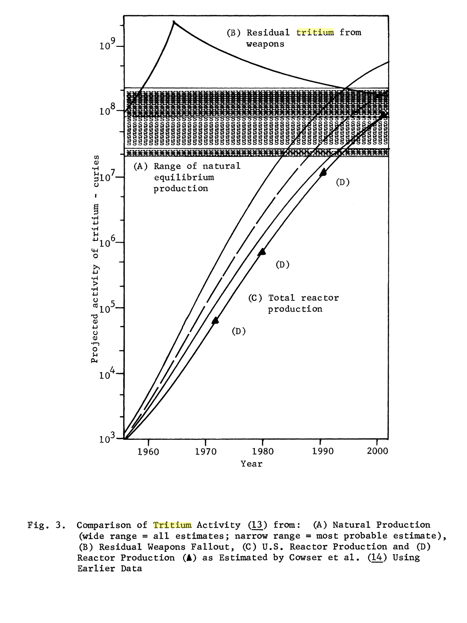
Die Menge an Tritium in Fusionsreaktoren liegt je nach Aufbau und Materialwahl größenordnungsmäßig zwischen 1 kg und über 10 kg und stellt ein kritisches Sicherheitsrisiko dar. (Abbildungen 2-1 und 2-3, Tabellen 2-1 und 2-2 in Jackson et al., 1985 - im Cache).
Zum Vergleich: Die Menge an Tritium in der Atmosphäre liegt zwischen 2 und 20 kg, Maximum in der Mitte der 1960er Jahre, der Zeit der Wasserstoffbombentests: 10 kg (im Cache) bis 200 kg
Calculation of Particle Removal Velocities in the Mecklenburg Bay Based on the Thorium Deficit
The Baltic Sea is continuously being fed with large amounts of contaminants. They adsorb to the particulate matter suspended in the sea water. This particulate matter is constantly generated and settling onto the sea bed. This way the contaminants are continuously being removed from the mobile phase of the Baltic ("sedimentation"). If one knows the particulate removal rates one can -on the basis of a balance between feed and removal- calculate the stationary mobile contaminant inventory as a function of the parameters determining the settling process.
The presented research shows a methodto determine the particulate removal rate.
1,342 K Mathematica version 2.2 Notebook.
Wolfram Research, Inc. provides you a free copy of MathReader with which you can read the above notebook.
Meine Kommentare zum Blog "Umwelt-Desaster im Atommülllager Asse II"
Genehmigung von Publikationen
kritische Diskrepanz beim Pu-Inventar
falsches Tritium-Inventar
Unsicherheiten (im Cache)
Strahlenschäden in Steinsalz
Intransparenz bzgl. der Gründe für Abbruch des Asse-Radiolyseprojekts
Bildung sekundärer Radionuklidlager
Barrierenbruch zum Biospärenwasser
Whistleblowerschutz in den USA
neue Bürgerbeteiligung und Transparenz in den USA (im Cache)
Vorschlag zum Umgang mit großen Unsicherheiten: Analogie zwischen nuklearer Endlagerforschung und Klimaforschung
Endlagerung von hochaktivem Abfall (HLW)
-
Radiolyse von NaCl im Endlager für hochradioaktiven Abfall: Strahlenschadenbeurteilung der Gesellschaft für Anlagen- und Reaktorsicherheit (GRS) und des Zernike-Instituts der Universität Groningen
Das deutsche nukleare Establishment hat sich -trotz besserer Beratung- auf eine unzulässig vereinfachte Darstellung von Strahlenschäden im Steinsalz festgelegt.ÊNach wenigen Monaten Einarbeitung in die Problematik kann ein Naturwissenschaftler die Unhaltbarkeit dieser Modellvorstellungen offenlegen. Die Strahlenschädigung und ihre Folgen für die Endlagersicherheit können auf Grund des heutigen Stands der Wissenschaft nicht vorhergesehen werden. Die Reaktorsicherheitskommission berät die Bundesregierung falsch.
Endlager für hochradioaktiven Abfall: Geologisch/geochemische Probleme und IT-basierte Lösungswege
Zusammenfassung der ungelösten geochemischen und gesellschaftlichen Probleme.
Zwei in Deutschland unbekannten Mechanismen des Endlagerversagens.
Formen der Transparenz und Bürgerbeteiligung.
Whistleblowerschutz.
Ungelöste Probleme bei der Endlagerung von hochradioaktivem Abfall (HLW)
Beispiele für die gravierende Inkompetenz der deutschen Institutionen, die sich mit Langzeitsicherheit befassen. Das weltweite wissenschaftliche Grundlagenwissen und die notwendigen Vorgehensweisen sind so unzureichend, daß standortspezifische Forschungsprojekte zur Langzeitsicherheit sinnlos sind. Ohne einen Paradigmenwechsel wird die Forschung wie in der Vergangenheit weiterhin Einzelergebnisse produzieren, deren Relevanz im Hinblick auf die Langzeitsicherheit unbekannt ist.
-
Der Status Quo in der Langzeitsicherheitsforschung, erläutert an einigen Beispielen, und Thesen zu seiner Überwindung.
Barrierewirkung des Deckgebirges im Raum Gorleben: Eine Kritik
Die den Berechnungen zugrundegelegten Annahmen blieben schon zur Zeit ihrer Veröffentlichung hinter dem Stand der Wissenschaft zurück, wie er in der internationalen Literatur zugänglich war. Memmert nimmt unzutreffenderweise eine kontinuierliche Verteilung und einen stetigen Abfluß der ins Deckgebirge ausgetretenden Radionuklide an. In der Geosphäre und in der an sie gekoppelten Nahrungskette laufen jedoch Anreicherungsprozesse ab, welche einen Teil des hochaktiven Endlagerinventars in begrenzte Biosphärenbereiche verlagern, also für Jahr(hundert)tausende ausgedehnte "hot spots" bilden.